
In an environment drenched in party politics, a new idea has emerged onto the scene of governmental transparency. This idea encompasses a conflict between the security of a nation and whether the U.S. government’s checks match their balance. In other words, what (confidential) information should be released in spite of the possible repercussions?....

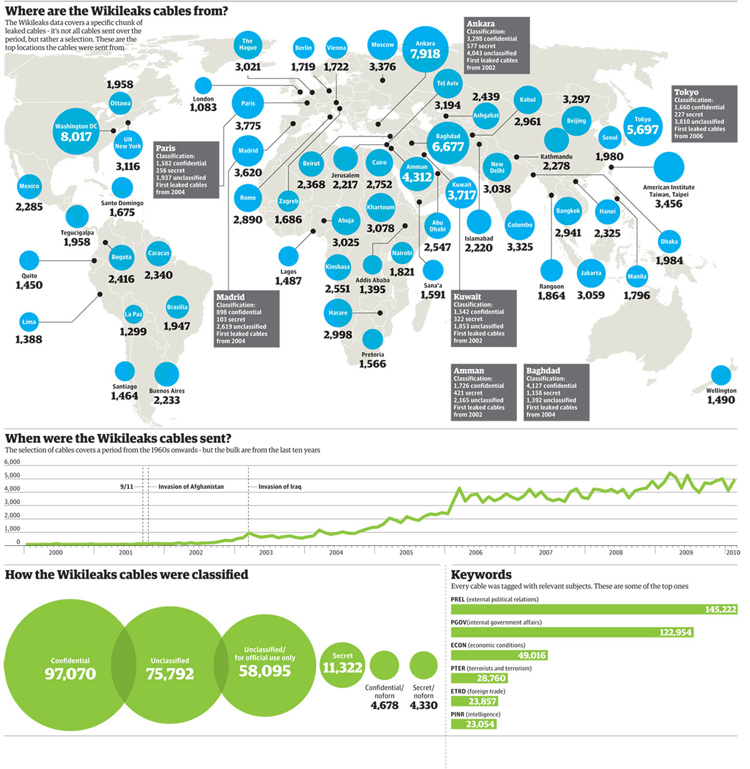
Because face it, any of the exposed information has an effect in some way or another. But be keen to understand the spectrum of information due to the copious amounts published, discussed, and regurgitated out of a plethora of news media gizzards. Among all this info which is regularly updated every 21/2 seconds (no kidding), subjects range from reports on “Advanced Chinese Technology,” clandestine bombings in Yemen, and even a backhand to Spielberg’s new movie project based on Wikileaks. “This is how bullshit ends up being history,” read a note from a Wikileaks’ twitter feed Wednesday in regards to the potential image the film could portray. It seems Wikileaks has seeped effectively into our generational culture. First, a Spielberg film then Arcade Fire makes some witty shirt with the Wikileaks’ globe timeglass logo at the center.
After a while, most people will know more than they would like about Wikileaks and can rest at ease knowing that the government won’t encroach on their God given rights. Only one problem exists in this process of mainstream education: a sincere opinion cannot be formed without knowing the proper context and extent in which all the reports are being published. For instance, when comparing the Wikileaks’ reports to the Pentagon papers, it would be irresponsible to directly associate the two just because the origin of conflict is the same. What must be examined are the facts. What’s being released, who is being affected, and whether the effects are fallacious or legitimate. Keep in mind that I will add my perspective only when light needs to be shone on a foggier discrepancy.
Let’s get contextual. You have an international non-profit organization geared towards publishing anonymous submissions of confidential and classified content from various sources throughout the world. These submissions are coordinated by "Chinese dissidents, journalists, mathematicians and start-up company technologists, from the US, Taiwan, Europe, Australia and South Africa” then released in a manner aimed towards the most appropriate attribution and relevance. Critics and government officials (recently judiciaries) target this manner, claiming that it is in fact a detriment to national security and international diplomacy.
Meanwhile, any audience member in this house of leaks can’t help but lose confidence in the nation’s competency. Day upon day, leak upon leak, bring ethical questions to the table already covered with big time bank troubles, housing just crawling back from the edge, and the ongoing war on terrorism falling through cracks of transparency. Underlying all this exists a center of attention, Julian Assange. Reminiscent of Daniel Ellsberg’s exposure during the release of the pentagon papers, media throughout the U.S. broadcasted the “reveals” Wikileaks had to offer.

The more damaging of these releases gained exposure early in Wikileaks’ chronology. Less than a year into the organization’s founding, footage of an Apache helicopter targeting and killing innocent Iraqi civilians straight from the gunsight was published under the moniker, Collateral Murder.
From the very beginning, Assange has been the face of anonymity and liaison between the media and Pandora’s box. The only result being attached attention to Assange every time Wikileaks is brought to metaphorical and literal trial. Arguments that rally around comparisons to social and business ethics combat each other while Wikileaks continues to hurdle towards their primary interest of “exposing oppressive regimes in Asia, the former Soviet bloc, Sub-Saharan Africa and the Middle East.” Secondly expecting, “to be of assistance to people of all regions who wish to reveal unethical behavior in their governments and corporations.” But in essence, “[Their] goal is to bring important news and information to the public.” So where does that leave those affected?
The priority will be given to those in combat or operations against the Taliban, insurgents, or terrorist activity. A major case being claimed endangerment of Afghan informants working with NATO via release of confidential information including specific names associated with distinct operations. In the instance that this Wikileaks information was truly endangering a large number of in the fray informants, the publishing of informant identities if not the entire operation itself should be under scrutiny. However as it seems, the shear number of reports released by Wikileaks (the scope of their exposure) is used as evidence behind inevitable endangerment of troops and informants.

Realistically, Assange and the members of Wikileaks have an experienced sensitivity with classified information and consequent Internet media disbursement. Assange acquired knowledge of the consequences poised by obtaining classified government information through illegal means in his good ol’ computer hacking days of the early 90’s. Despite having an Internet veteran, ruffian in style, the dissidents working from inside of China have to deal with harsher censorship and consequences when de jure is infringed upon.
"We have read more leaked documents than any other organization -- apart from spy agencies -- on earth. So if anyone can apply that policy, surely we can do it."
- Julian Assange
Given this type of circumstance, an experienced base of operations for a revolutionary news source provides faith for reports that shed light on some of the most powerful guys in the room. These particular guys just happen to be some of Wikileaks’ harshest critics, among those either skeptical of Wikileaks effort in unveiling major secrets or of the ethicality of their published material.
Figures like Afghan President Hamid Karzai along with the harsh opposition provided by other Middle East “allies” such as Pakistan further polarize this vast discussion of transparency. Instead of the information actually being taken into account, the figure heads (whether it be Assange or another primetime character) are clogging up the intake. With ongoing allegations of rape and sexual assault held against Assange by Swedish authorities, the story of free press has transformed into a political superstar dodging arguments against his person. It even came to point in which Assange refused to speak about those alleged circumstances, walking off a television set as the reporter tried to pry out juicy information not referring to Wikileaks.
So this is what the situation as has come to: a stalemate of trust. One end carries an over powerful government dependent upon secrecy and non-disclosure. The other end poses a new way of exposing secrets, Costco style, while maintaining an utterly anonymous base of operation. Two radical ends exist for a public not sure of whom to trust. They could either trust the government who vowed to keep them safe, at the expense of disclosing important information or they could trust a non-profit vowed to keep them informed, at the expense of possibly disclosing inappropriate (cause of endangerment) information. Now that a large amount of the information is already out of the table (we’re talking thousands upon thousands of cables) the time has come to make a decision.
But don’t make it based upon some pundit, friend, or parent. Read some of the cables, most are pretty accessible to understand and to reach. Interpretation of what you read can be no more than asking “does this hurt anyone?” The answer to such would give you a more responsible, not he said she said, opinion on what Wikileaks is doing and if it is appropriate or not. Now of course, attempting to decipher the convoluted array of information is not necessary. But a rough idea will suffice in this game of knit fine points. As long as you know who you can trust.
"The only effective restraint upon executive policy and power... may lie in an enlightened citizenry -- in an informed and critical public opinion which alone can here protect the values of democratic government."
-Justice Potter Stewart


No need to double space. Look at the other posts -- you can tell yours looks too spread out.
ReplyDeleteIs governmental transparency really a new idea?
And are we talking true transparency or just opacity? Partially see-through?
Your thesis is a question. This is not good. Figure out what you want to advocate and state it declaratively.
I don't understand what you're trying to say in the second paragraph. You're being very witty and have an excellent command of language, but you lack clarity.
3rd paragraph you're warming up to what could be a thesis, but haven't quite reached one yet. Still, some good initial points here.
When you say, "Let's Get Contextual," I was really hoping for some interpretative insight that would color how I should perceive wikileaks, but instead I got an information dump of a whole bunch of basic facts I already know.
You make things sound oh so very good (pandora's box, ethical combat) but it's hard to find the substance underneath the veneer. What are you saying that's weighty on an argumentative level?
should be under scrutiny." How under scrutiny? What does that mean? Sounds good but is actually vague.
"However as it seems, the shear number of reports released by Wikileaks (the scope of their exposure) is used as evidence behind inevitable endangerment of troops and informants." Okay, so you're saying that the evidence used against them is quantity rather than explicit evidence of endangerment in the field. Develop this idea. Criticize. You bring it up for a single sentence and then drop it.
"the story of free press has transformed into a political superstar dodging arguments against his person." This deserves to be a TS, not hidden inside a paragraph. Develop this idea. Support it. You keep on giving me beautiful one-liners and then dropping them like hot rocks.
LOVE "stalemate of trust." Love Costco style. Love the conclusion which is basically a call to action.
Overall:
You are a very good writer in terms of style and word control and diction level and sentence rhythms, so good, in fact, I feel like you've been able to skate along in previous writing classes by sheer force of your stylistic will. But there's too much hollowness beneath the veneer of your language.
You have a hard time organizing ideas and explaining things in an organized fashion and of making solid argumentative moves that are clear. It's difficult for me to actually find out what arguments you're making. You seem to skip from idea to idea without getting in depth on many of them.
But all that to say, if you can control your ideas and really flesh out your arguments, you're going to have quite the writing arsenal.